Evaluation
I am pleased with the outcome of our film, I think it flows nicely and has a strong storyline that people will care about. David Taylor is a likeable character and plays on the camera well. He is entertaining yet serious too – he has a message he wants to say and is determined to help young people which is very admirable and something people want to hear about. For this project I did a lot of research which helped me learn the different variations of documentary film there is and the different ways you can portray them. I found out a lot about the issue before starting, by reading different news articles and videos around the subject. This made me more aware and certain that it is a topic that will work for a documentary film. I did an extensive amount of research on documentary film making, which helped a lot. For example the BBC five shot rule helped me when choosing what b roll to include and in what order. By researching short form documentaries it helped us shape our film, knowing what techniques you can use and how to make a story short but still effective. Me and Lowri did the filming, when filming the interview we used one DSLR camera and then filmed on our mobile form a different angle. Today more journalists are using their phones because of their practicality and mobiles these days’ camera quality are just as good. We also recorded the audio on our phone as back up. Before we started filming we tested out the audio to ensure it was working correctly. It is a shame that the quality of the film recorded on the camera isn’t great because of the flickering – next time I would use a phone as the quality on that was much better. We also used a clip mic. We then met up with him again to film him singing, we used a mobile this time. When he was singing lot of people approached us about him and one elderly woman came up to us which worked perfectly for us as he spoke in his interview how a lot of older people appreciate him and his music. We included this clip as b roll in our film. We also used b roll of him walking through Newport. I like the use of the videos of him singing infront of crowds as it shows the audience that might not be aware of him that he is a growing artist and has a lot of supporters. I think that his song at the end works well as it ties in with the religious aspect of his music and he is very energetic and passionate. We tried to fix the flickering of light in the film but were unable to – that is the main issue I think the film has. Sometimes the audio is slightly jumpy too. Another thing we could have done was be more prepared and maybe taken more than one camera and also a tripod to make it more stable. I also need to work on my time management and getting more feedback and help on my work.
Editing Process
The longest part of the editing process was cutting down the audio. We had 17 minutes of audio and cut it down to 7 minutes, this was from our interview with him. We chose the most important parts of the interview, that told the story and had the most interesting parts. We used the split clip tool too separate and cut out everything. This helped us create a flow – which was still quite jumpy. To solve the audio pops we used the transformation keyframe and had it at a 2 second duration. After this it still didn’t flow the best, so we used the cross dissolve tool which made it run smoother. Lastly, we added b roll to the film. We listened to the audio and figured what b roll would fit best depending on what he was talking about. We added some text to the film and included his social media to help promote him. We edited the clips to modify the exposure. When filming the interview, the lighting wasn’t the best. This created a flicker in the interview we tried to rectify this with the exposure but it didn’t make much difference. We should have re shoot this but over Christmas he had a very busy schedule so we were unable to do so.
Why Misfit Media
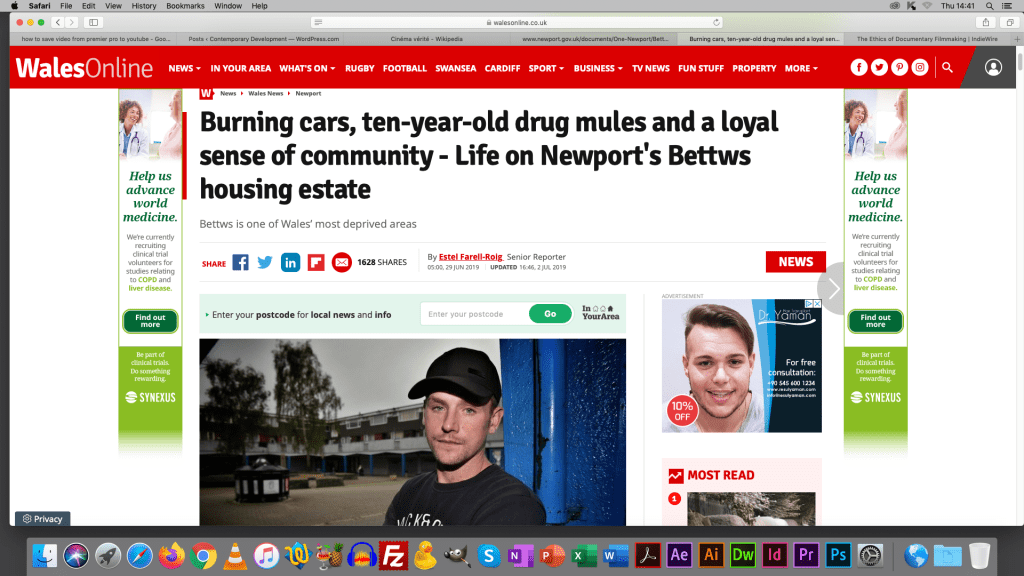
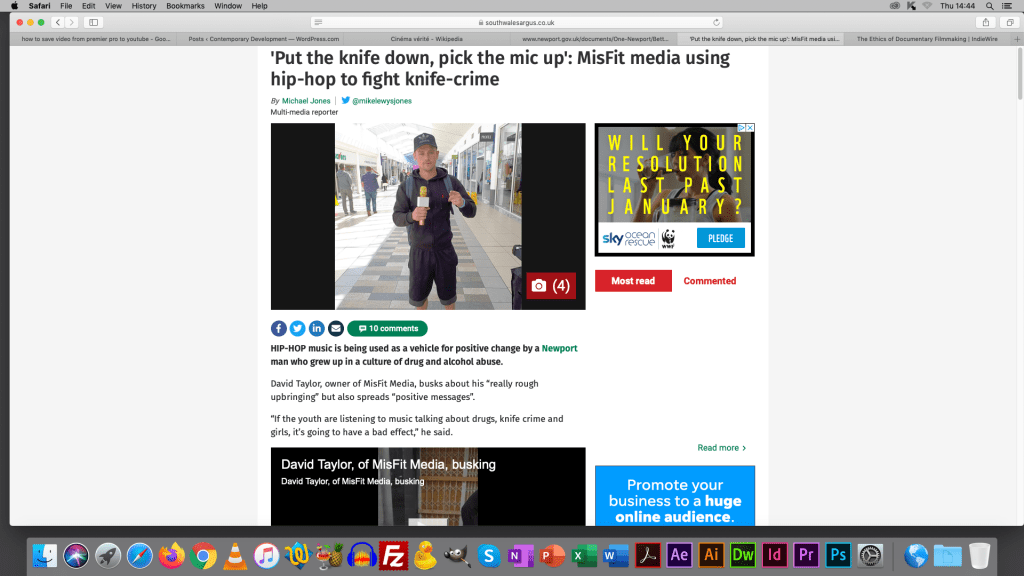
He is has been in local news a lot and has a following. He just needs to spread his message more and we could help do that by making his documentary film.
Who is my Target Audience?
- People of South Wales
- Young people
- Older people
- People battling mental health/substance misuse issues
- People wanting to make a change
- Music enthusiasts
I can vision my documentary video being published on websites such as Vice, YouTube, Vox, I-D
DOCUMENTARY FILM CAREER
Becoming a documentary filmmaker is among the most challenging and promising career options of today. The field of documentary filmmaking is a perfect blend of reality, creativity, and technicality. To excel in this field of filmmaking, one has to be creative, innovative, decisive, open-minded and technologically savvy. A documentary filmmaker is responsible for taking the concept for a film project and turning it into a finished film by assembling a cast and/or crew and “shooting” the sequences.
The job of a documentary filmmaker involves managing a large production crew of the film or TV production, hiring and appointing members of the technical crew and cast, managing the actors working in the film/TV, securing or procuring finance, studying the documents and retrieving relevant information. Hence, a successful documentary filmmaker needs to be a visionary, who possesses the quality of creative interpretation of reality.
Types of Job Roles Documentary Filmmaker
There are a number of job profiles that one can target based on the level of interest. Following are some of the documentary filmmaker job profiles that one can opt for:
Documentary Producer: One of the most important jobs of a documentary producer is to generate money to make a film. He/she oversees the creation of the entire film and manages the budget and the staff. He/she also works with the director to hire production staff for production assistance.
Documentary Director: The job role of a documentary director includes central duties in pre-production, the actual filming, editing and post-production work. The job of a documentary director also includes creating a production schedule, gathering existing footage and other production elements like photos, documents etc and writing a script outline.
Programme Researcher: A programme researcher generates programme ideas, prepares cost accounts, organises meetings and interviews with appropriate people. He/she also organises, plans and coordinates the production of films/ television and undertake relevant background research.
Documentary Sound Designer: He/she is responsible for creating the overall auditory effects of a film, or TV show. He/she can choose, edit and remix music, work with live musicians in the theatre or work with a composer to make original music.
Writer: The job of the documentary writer includes working with the director and editor to shape the narrative of the film/ TV show as a whole. He/she understands the different ways that films affect audiences and have an in-depth understanding of the story, plot and narrative.
Becoming a documentary filmmaker is among the most challenging and promising career options of today. The field of documentary filmmaking is a perfect blend of reality, creativity, and technicality. To excel in this field of filmmaking, one has to be creative, innovative, decisive, open-minded and technologically savvy. A documentary filmmaker is responsible for taking the concept for a film project and turning it into a finished film by assembling a cast and/or crew and “shooting” the sequences.
The job of a documentary filmmaker involves managing a large production crew of the film or TV production, hiring and appointing members of the technical crew and cast, managing the actors working in the film/TV, securing or procuring finance, studying the documents and retrieving relevant information. Hence, a successful documentary filmmaker needs to be a visionary, who possesses the quality of creative interpretation of reality.
Types of Job Roles Documentary Filmmaker
There are a number of job profiles that one can target based on the level of interest. Following are some of the documentary filmmaker job profiles that one can opt for:
Documentary Producer: One of the most important jobs of a documentary producer is to generate money to make a film. He/she oversees the creation of the entire film and manages the budget and the staff. He/she also works with the director to hire production staff for production assistance.
Documentary Director: The job role of a documentary director includes central duties in pre-production, the actual filming, editing and post-production work. The job of a documentary director also includes creating a production schedule, gathering existing footage and other production elements like photos, documents etc and writing a script outline.
Programme Researcher: A programme researcher generates programme ideas, prepares cost accounts, organises meetings and interviews with appropriate people. He/she also organises, plans and coordinates the production of films/ television and undertake relevant background research.
Documentary Sound Designer: He/she is responsible for creating the overall auditory effects of a film, or TV show. He/she can choose, edit and remix music, work with live musicians in the theatre or work with a composer to make original music.
Writer: The job of the documentary writer includes working with the director and editor to shape the narrative of the film/ TV show as a whole. He/she understands the different ways that films affect audiences and have an in-depth understanding of the story, plot and narrative.
Shooting on Mobile
CLEAN THE LENS
It sounds silly and simple, but this is always a great place to start. It’s the equivalent of remembering to take the lens cap off of a camera. It’s something so obvious that it’s often easy to forget. Before you shoot any video with your smartphone, make sure the camera’s view isn’t obstructed, and give it a quick swab.
CHECK AND SET YOUR SETTINGS
Smartphones might be limited in functionality compared to more dedicated video cameras, but that doesn’t mean they’re only capable of shooting one type of video. Most premium smartphones these days have a few different resolutions and frame rates to choose from.

On Android phones, these settings are usually right inside the main camera app, either tucked behind the settings gear wheel, or accessible via a toggle button. Apple, however, has buried these options in the main settings menu. You have to back all the way out of the camera app, go into Settings, scroll down to Photos & Camera, and then scroll down to the Camera section.
Once you’ve found them, here’s a quick breakdown of the three most commonly used video settings:
- 1080p at 30 frames per second: the other standard resolution / frame rate combination. The difference here is your video has more frames displaying every second, which gives the footage an even more fluid look that is closer to how you would have seen the scene in real life. The choice between 30 fps and 24 fps is mostly an aesthetic one — both should display correctly wherever you post.
- 1080p at 24 frames per second: one of the two most standard settings for shooting video. 1080p is the resolution, a stand-in term for how many pixels (1920 x 1080) are captured in each frame of the video. 24 frames per second (fps) means you’re capturing 24 frames every second. That speed is just above the low end of what our brain is able to perceive as fluid video, but with just enough imperceptible stutter that it creates a pleasing, cinematic look. (That balancing act between fluid motion and intangible surrealism is why 24 frames per second is what filmmakers use in most movies.) Note: You’ll only be able to shoot in 24 fps if you use an app that allows this frame rate, like Filmic Pro.
- 1080p at 60 frames per second: shooting at 60 fps will give you an even more fluid-looking video. It’s also where we can start to talk about…
SLOW MOTION
Anything shot at 60 fps or higher (like 120 fps or 240 fps) can be turned into slow motion footage. If you have a phone that shoots in 120 or 240 fps, there’s a good chance it already has a way to slow this footage down for you. For reference, 120 fps is about five times slower than normal speed, and 240 fps is 10 times slower.

To shoot in slow motion on an iPhone, open the camera app and swipe right on the modes listed above the shutter button until you get to “Slo-mo.” (You can also just tap on it when you see it at the edge of the app.) In order to change how slow your footage is, you’ll have to go back out of the camera app to the main Settings page and change the speed there. With most Android phones, these settings can again be easily changed inside the camera app.
To view the slow motion video, tap on it in your phone’s photo gallery or camera roll. Your phone will automatically slow down the middle 80 percent of the video. To change when the slo-mo effect starts and stops on an iPhone video, tap the settings icon below the video, and then drag the little hash marks to the left and right.
PACE YOURSELF
Shooting a lot of video, especially 4K video, is going to clog up your phone’s storage faster than almost anything else. So making sure you have a solution in place to back that footage up is key.
Find a storage solution that works for you, whether that’s cloud-based (Google Drive, iCloud, Dropbox, etc.) or local storage (external hard drives, or maybe even just your laptop or desktop) and get into the habit of backing up your footage regularly.
I have chose to include this because for the interview we are using a DSLR to shoot the interview. But for our b roll we are going to use an iPhone. This research is helpful as it tells you all the settings you chan change and different things that phones can do.
10 Influential Documentary Film Makers
“Cinéma Vérité: the art or technique of filming a motion picture so as to convey candid realism.”
– The Merriam-Webster Dictionary
It is possible you have checked out the IFC comedic series “Documentary Now.” If so, you may be aware of how each episode is a clever parody of an established documentary. Or…a documentary that has had some influence on filmmakers to come. And yet, it is also possible you may have a latent knowledge of who they are and the role they’ve played in the history of cinéma vérité. So here, in no discernable order, are the pioneers who have developed techniques still used to this day.
1. The Maysles Brothers

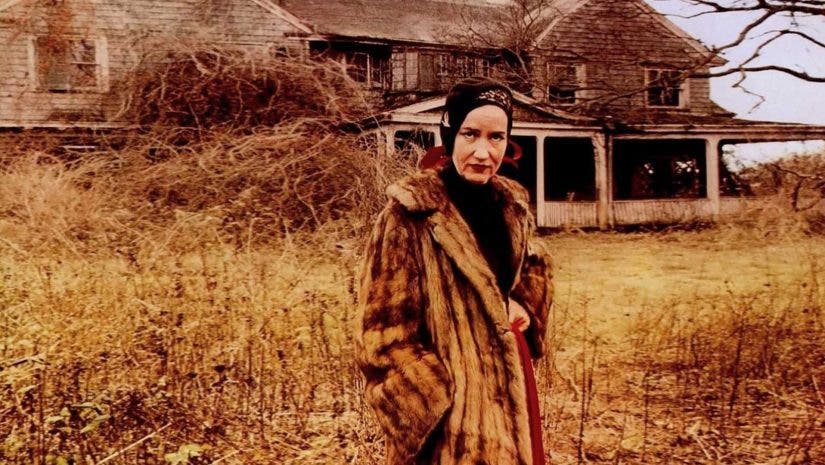
Proud members of the “direct cinema” movement, the Maysles began their career shooting two documentaries behind the Iron Curtain. Albert and David were a one-two punch; Albert would work the camera while David recorded the sound. Together they redefined the approach to documentary filmmaking. Whether it involved following the door-to-door activities of a “Salesman” or capturing a traumatic event in what was supposed to be a concert film (the galvanizing “Gimmie Shelter” which is about the notorious Rolling Stones concert at Altamont), the Maysles had an uncanny track record for being at the right place at the right time. As a testament to their role as influencers, their New England gothic “Grey Gardens” is not just a legendary documentary in its own right but has inspired both a Broadway musical and HBO film starring Jessica Lange and Drew Barrymore.
2. Errol Morrishttps://www.youtube.com/watch?v=Mnlq0TurT3c
After completing his first documentary “Gates of Heaven,” Morris failed to get funding for numerous projects until he finally met Dr. James Grigson, a psychologist whose court testimonies led to many death sentence convictions. Believing that “Dr. Death” should be his next subject, Morris then decided to point his lens at the case of Randall Dale Adams, a man who was facing execution due to a legal technicality. The result was the compelling “The Thin Blue Line.” Morris’ film (and approach) engendered a whole generation of investigative filmmaking. His technique of combining talking head interviews with dramatic reenactments influenced almost every true crime reality series on TV.
Here’s an amusing bit of trivia: famed German auteur Werner Herzog (himself the subject of “Burden of Dreams” and a respected documentarian in his own right) was skeptical that Morris would complete anything. Once “Gates of Heaven” enjoyed a theatrical release, Herzog made good on his promise to eat his shoe. And he did. And it was recorded for prosperity as a short film titled “Werner Herzog Eats His Shoe.”
3. Marcel Ophuls

In 1933, Marcel Ophuls and his family left his native Germany and settled in France. Although he started off as a feature filmmaker, it wasn’t until 1969 did he utilize his background in television news reporting by directing “The Sorry and the Pity.” An examination of the collaboration between the Vichy government and Nazi Germany during World War II, its influence cannot be denied, especially in the way it depicts the psychological effect war has on a single populace. It still remains as one of the most affecting peaks into wartime anti-Semitism and was nominated for an Academy Award in 1971. It has also been immortalized as Woody Allen’s obsession in the award winning “Annie Hall.”
4. Michael Moore
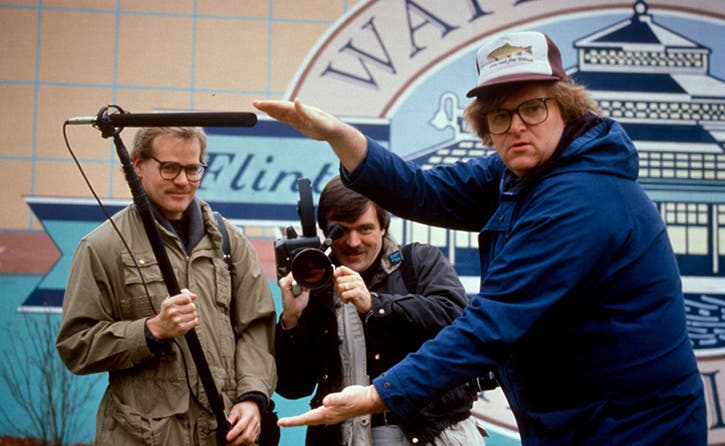
Former Mother Jones editor Michael Moore should be credited with introducing “gonzo journalism” into documentary filmmaking. For some his films err too much on the side of agitprop, but Moore’s insistence on interacting with his subjects on camera has provided some very amusing moments indeed. Born in Flint, Michigan Moore was fired from his Editor-In-Chief position. He then sued his former employer and used the settlement money to fund “Roger & Me.” A personal, sometimes satirical peek into the harsh economic climate of his hometown, it established an approach that would later appear in other filmmaker’s work like Morgan Spurlock’s “Supersize Me” and Bill Maher’s “Religulous.”
5. Ondi Timonerhttps://www.youtube.com/watch?v=_XSTwfdFwIY
While Ondi Timoner represents a younger generation of documentarian than those featured on this list, she deserves respect for two reasons. 1) she is the rare female working within a male dominated genre and 2) her ability to capture truth on camera, not to mention jaw dropping, real-life behavior on the part of her subjects almost acts as a harbinger for the reality TV programming yet to come. In fact, “We Live in Public” utterly predicted our future fascination with online content. Predating YouTube celebrity culture by only a few years, Timoner’s documentary focuses on one man’s attempt to launch an internet television network during the 1990s. It would offer a flagship series covering 100 individuals living together in a single space. Thanks to the constant surveillance of digital cameras, audiences were invited to view this experiment online twenty-four hours and seven days a week.
Although Timoner’s documentary was completed in 2009, it was her recognition and anticipation of the access of future media that insures her place as a principal influencer when it comes to documentary filmmaking. In fact, Timoner has started her own web network called “A Total Disruption” which features interactive, “cyber series” profiling modern innovators and thought leaders.
6. Frederick Wiseman

Boston born, former lawyer Frederick Wiseman was creating “observational films” around the same time that the Maysles and Pennebaker were shooting “direct cinema.” Although he has shunned the term cinéma vérité (he felt that to capture truth on camera one had to be purely objective in approach. And there is no way a filmmaker can be that objective), no filmmaker has been so connected to the movement. Although he spends a lot of time researching his subjects, most of the creative work goes into his editing. He followed his first film (the narrative feature “The Cool World”) with 1967’s “Titicut Follies,” a profile of the Bridgewater State Hospital. It exposed the ugly conditions its patients were forced to deal with and is an early example of just letting the camera “tell it like it is.” The movie was so controversial; the Massachusetts government successfully blocked its release. It wasn’t until 1991 when a Superior Court Judge allowed the film to be seen by the mass public.
Pennebaker began his career as an experimental filmmaker and would later co-found Drew Associates with documentarian Richard Leacock and journalist Robert Drew. It was a cooperative that would include Albert and David Maysles among its members. But it was Pennebaker’s “Don’t Look Back” that introduced a new sub-genre of documentary filmmaking: the candid coverage of a popular celebrity. The film offers up revealing, behind the scenes moments during Bob Dylan’s 1965 concert tour in England. As an extra bonus, “Don’t Look Back” also includes the now famous “music video” of Dylan dropping placards to his “Subterranean Love Sick Blues.”
8. Robert J. Flattery
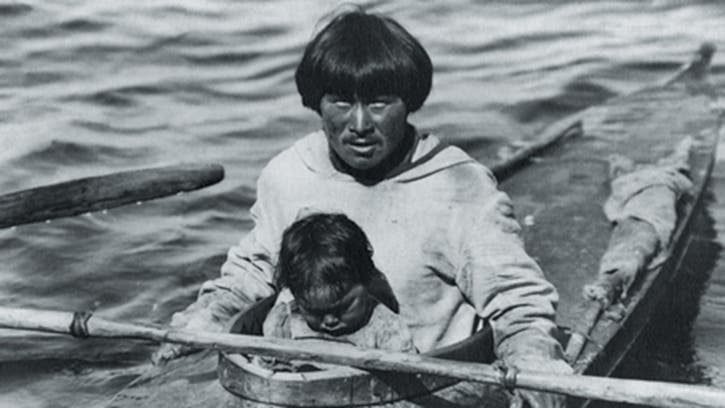
Robert J. Flattery was a writer who had made numerous trips to the American north while attempting to ingratiate himself within the Inuit communities. After securing funds from a French fur trade company, Flattery used the money to finance “Nanook of the North,” the earliest example of feature documentary filmmaking. Although “documentary” might be a loose term in this case as Flattery actually cast locals in key roles while staging some scenes for the benefit of his camera. However, “Nanook” was a huge success in 1922 thus ushering in a whole new genre.
9. Michael Aptedhttps://www.youtube.com/watch?v=f-U6RfKVzCs
In 1964, a UK television program titled “World in Action” aired what would be the first of a succession of documentaries profiling various subjects as they progressed from the age of seven through fifty-six. What resulted might be the most compelling reality series ever made. For almost five decades, audiences witnessed the growth of fourteen personalities representing the unique class differences prevalent in Britain at the time. Michael Apted himself would direct some high profile projects like “Gorillas in the Mist” and the James Bond adventure “The World is Not Enough.” But he continued to return the project that started way back in the mid ‘60s. Although it began as a segment for an hourly, television news magazine, the “Up” series would move on to feature length status and, ultimately, be released theatrically. Although “Seven Up,” “7 Plus Seven,” “21 Up,” et al., could be distinguished as the blueprint for the reality serial, it’s approach is anything but exploitive. And is often pointed to as the gold standard of the genre.
10. Ken Burnshttps://www.youtube.com/watch?list=PL706BA6BC60A82105&v=FN2huQB-DmE
Our last filmmaker is so influential; he has inspired many apps and post-production plug-ins promoting the “Ken Burns style.” Usually this encapsulates a combination of photo montage and motion design. But since 1990’s “The Civil War,” Ken Burns’ name became synonymous as a brand. Making use of archival footage and imagery, voice over narration and, yes, incorporating motion into still photography is a signature component in Burn’s work. His visually dramatic approach has been co-opted by many documentary filmmakers since.
Short Form Documentary
A website called “short of the week”, which has various short form documentaries about all different subjects, they are passionate about telling stories of any kind. You are even able to submit your own film to the website and they could publish it.
From how films are funded, produced, and ultimately consumed, online short films are paving the future of storytelling. Today, the most interesting stories aren’t being told in theaters or even on TV. They’re being told here on the web. This is where you find the storytellers who are breaking free from formulas, inventing new genres, and surprising the world with shocking new points of view. The next Spielberg, Tarantino, or Cuaron won’t be discovered at a film festival. They will first make their mark right here on the web.
For example, I found this video that I enjoyed watching, probably because it is close to home, in Maesteg. I love also love how they used subtitles because their welsh accents are so strong.
I like how up close and personal you get with Theodore, by being in his taxi car with him and his customers and seeing his home life. There are a lot of shots of the surrounding areas, of the beautiful scenery around which gives us a feel of what the community is like. It has a very sad tone but tells an important story of unemployment in Wales.
Another video I found was After Sophie, another short form documentary about a girl who killed herself. This is a topic which you would have to consider ethics in, you would have to approach the subject carefully, You cannot portray anything that isn’t true and be sensitive about it.
Actuality in Documentary Film
Actuality is the term for raw film footage of real life events, places and people as opposed to fictional films which use actors, scripted stories and artificial sets. Documentaries are not pure actuality films – rather they combine actuality with explanation, commentary, and perhaps even dramatization.
Voice-over
The voice over in a documentary is a commentary by the filmmaker, spoken while the camera is filming, or added to the soundtrack during the production. Through this the filmmaker can speak directly to the viewer, offering information, explanations and opinions.
Direct and indirect interviews
The interview is a common documentary technique. It allows people being filmed to speak directly about events, prompted by the questions asked by the filmmaker. An interview may take place on screen, or off screen, on a different set. Interviews in a documentary gives the viewer a sense of realism, that the documentary maker’s views are mutually shared by another person or source, and thus more valid. To achieve this much detail from what may be a one-hour interview, clips of only a few minutes are shown. Interviews on opposing sides of an issue may be shown to give the viewer comprehensive information about a topic.
Interviews are also a very important technique for character introduction. Lighting, color scheme, framing and camera angle all impact the audience’s perception of the person who is speaking. As with narratives, this can lend to a specific feel the director wishes to convey about the person speaking. The impact to the story is key, as the audience will form an opinion of the person based on the initial meeting.
Archival footage
Archival, or stock footage, is material obtained from a film library or archive and inserted into a documentary to show historical events or to add detail without the need for additional filming. This can include still images as well as archival film. The concept of archival footage can be extended to include the photography of historical material from archives which are used to illustrate to a documentary film and is also the main reason why archive footage is especially important to historical documentary filmmaking.
Re-enactment
Re-enactments are also often used in documentaries. They are artificial scenes of an event which has been reconstructed and acted out on film based on information of the event. Reconstructions generally provide factual information penguins, and give the viewer a sense of realism, as if the event really happened in front of them live. They often indicate that the footage is not real by using techniques such as blurring, distortion, lighting effects, changes in camera level, and color enhancement within the footage.
Montage
A montage sequence conveys ideas visually by putting them in a specific order in the film. Narrative montages involve the planning of sequence of shots used to indicate changes in time and place within a film. Ideational montages link actions with words, and are often used in documentaries.
A different positioning of shots conveys different ideas to the viewer. For example, a montage containing a negative theme followed by a positive theme may give the viewer the idea that the positive theme is the main theme of the montage.
Montages in documentaries are usually linked with words that characters say. This visual representation of the characters thoughts helps position the viewer in the story, and helps the viewer better understand what the character is saying. It visually presents a progression of ideas on a screen.
Exposition
In a documentary, the exposition occurs at the beginning and introduces the important themes of the film. It is important because it creates the viewer’s first impression and introduces the viewer to the content.
Dramatic segments of the documentary are specially chosen in order to grab the viewer’s attention. These shots are specifically positioned, such that the montage positions us to believe a certain theme presented by the documentary and thus the documentary presents its view much more persuasively to the viewer.
These are different components that help build a documentary film. I learnt that are many different techniques you can do to help make your film more interesting and factual. By including archive footage it makes the story more believable to the viewer. The use of our b roll and images in the film will help build this.
Interview Techniques
1. Don’t start with the cameras rolling
Start instead with building trust. Discuss unrelated issues to help open up to the subject. A few preliminary interviews without a crew or cameras may also be necessary to help develop a friendship. In the end, you’re building a relationship and any relationship that has any weight to it is equal in its contributions. If you enter their home and force them to tell you their story without giving anything back, it’s hardly conducive to building a balanced relationship and this will show in your final footage.
When you do show up with your crew and cameras, get your subject familiar to the lights and the camera but don’t start running footage until you can see that they are comfortable with the people and the equipment around them.
2. Start by getting the basics
Ask questions about family history, their personal background, their educational background etc. This allows them a few easy questions to get started.
3. Ask permission based questions
When you get to asking more difficult questions consider asking “permission based questions”. You can start these questions with phrases like
“I’m going to push you today if that’s okay?”
Or
“Do you mind if I ask you some uncomfortable questions?”
4. Don’t always fill in their pauses
When you’re interviewing someone you may feel like you want to “rescue’ them from a pause. However, it’s not always beneficial to fill in these pauses. Give your subjects time to think and explain themselves. This is where you often go beyond the basics and get access to deeper and more personal information. Watch a Werner Herzog documentary to see this technique in action. He uses it all of the time and it adds for some of the best interview responses.
5. Put your subjects in touch with pain or their hopes and dreams
If you’re looking for passionate testimonial then touch on the emotional buttons of pain and joy. However, if you’re not sincerely interested in the responses the subject will sense that and will withhold information. You must be genuinely interested in your subject for them to open up to you.
6. Use other peoples labels
If your subject is talking about their wife whose name is Amanda and he’s referring to her as Amanda then you should use those work markers as well. Don’t refer to her as “his wife” if he is referring to her as Amanda.
7. Ask questions in the same sensory metaphor
People often speak in sensory metaphors. The three types are
Auditory
Visually
Kinaesthetically
8. Empathy
If people are reluctant to give you information you must think about empathy. What would you do if you were in their situation? What things would make you talk? Because only when you understand this can you unlock the key to that information. Again, often talking about yourself and similar experiences can help reduce the chances that they will think you’re judging them negatively.
9. Ask open ended questions rather than leading questions
Leading questions get your subjects to answer in “yes” or “no” responses. However, you’re often looking for much more in depth information. Therefore you need to ask “open ended questions”. These questions often start with “why” or “how”. Alternatively they may be phrased as:
“Can you tell me more about that?”
10. Repeat their words if you want more information
If you feel you’ve almost unlocked a goldmine of information but your subject stops, you might consider using the last word in their sentence to prompt them to continue.
For example, your subject may end their statement about being fired by their employer of 20 years by saying “it’s just not fair”. You’re next questions could simply be “fair?”
This simple question will allow them to continue speaking in more depth about the issue at hand.
CINEMATOGRAPHY
The cinematographer or director of photography (DP) is the person in charge of actually shooting the film. He is the head of the camera and lighting departments, and as such he has a big role in the making of any film.
This was useful because it taught me that I need to prepare my interview questions beforehand and have an order. Then it makes it easier to tell the story. It is also important to be polite and respectful to the person you are interviewing.

