In our film we will be using b roll of David performing with children in the background, we have to be careful to get permission to use this as there are children in the clips.
Ethics

Documentary filmmakers, Quinn said, need to have a sense of the ethical questions or concerns that will affect their work. It’s on a different scale than journalism, simply because doc filmmakers spend so much time with subjects, sometimes years, that they become deeply involved in the intimate aspects of their lives.
“We as documentary filmmakers, I feel, have a responsibility towards ethics,” said Quinn. “You owe your audience to tell the truth, to get to the bottom of the story, to be accurate in what you’re presenting.”
He brought up an instance on one of his films when a particular subject no longer wanted to be involved. He and his team held a meeting with the woman and explained that she could see the film before it was finished and express any concerns.
“We say this to everyone at the beginning, we say you’re going to see this film before it’s done. You can see it when it can still be changed. We’re going to try to convince you that we need you in this movie; that it’s important for the story that it’s good for society in general to tell this story, and why your part of it is so important. At the end of the day, if I can’t convince you we’ll take you out of the movie.”
Quinn then went on to explain that the rules that apply to an average person, might not apply to someone who is already famous.
This tells me to be vary careful when filming of the subjects discussed and who is in it. As by producing a documentary film, you are portraying actuality and it is important to portray people as they are and not manipulate anything. It is important to be respectful and always get permission when needed.
BBC Five Shot Rule
The BBC five shot rule: shot in this order (it’s important always to shoot in this order because they’ll cut together seamlessly)
1. Extreme close up on the hands
2. Extreme closeup on the face
3. Medium shot: hands and face in same shot
4. Wide shot or over the shoulder view of the action
5. Creative shot (make it very interesting: birds eye, worms eye view)
Similar to this, Alfred Hitchcock always follows by the three montages of film making, here is a video of him explaining this.
This is helpful as it covers the essential things needed to create a visually aesthetic film. It is also from the BBC, who create thousands of acclaimed films and is a reliable source.
Shooting a Documentary
Tell a story you care about
Start with a subject that excites you. If you’re lukewarm about the subject matter, chances are, the final movie will be too. Make a documentary you’re passionate about and makes sense to you. There will be plenty of people who don’t “get” your idea. But if you get it, that’s what counts.
David Taylor’s story is something that I care about as it is a positive message to young people. It shows that no matter what you have done in the past, you can change your life and he is a positive role model.
Research
Learn everything you can about your documentary subject. Sometimes the story lines are obvious, sometimes not. Do a lot of digging and follow leads. This is where you put on your reporter hat. Gather facts and search for leads on interesting characters and story lines.
David Taylor is well known in Cardiff/Newport so I already knew a lot about him. But before filming we met up with him to plan out what we were going to discuss and include in the film.
Make a Plan
Create an outline. Think about how you’re going to tell your story. What’s the structure? The style? Is there existing footage or photos that help tell your story or will everything need to be shot brand new? Who is your primary character(s)? What are you core story points? What are the elements of your story that are compelling and/or make you “tingle” with intrigue? How can you create that intrigue for your audience? Is there some existing situation you can film or do you need to create the moment?
The main story of the film is about his life story, and how he overcame many troubles and found faith. Also the organisation he created Misfit Media – we wanted to promote this and help him get more attention as it is a good cause.
Create a Shot List
This is a list of the footage and interviews you’ll need to make your movie. Think of it as your list of “ingredients”. Depending on the complexity of your project, you may or may not need to create a budget.
Start Shooting
Are you making documentaries for the web, mobile devices, television, theater? Maybe a combination? Keep in mind how your movie will be viewed because that can dictate your shooting and storytelling style. (tiny details off in the distance will not be seen on an iPhone). Make sure when you’re shooting an event to capture a variety of angles including close-ups, medium shots and wide shots.
Write a Script
Once all of the footage is shot and you’ve gathered the various production elements, time to start organizing it into a script. Pinpoint the most compelling elements of your story and start crafting “mini-scenes” around those events. A script isn’t necessarily what’s spoken or a voice-over. A script describes what the audience is seeing and hearing.
Begin Editing
First you’ll need to choose your video editing computer and video editing software. Once you’re all set with equipment, you’ll start putting down your clips of footage one right after the other in a sequence. The art with editing is to create a “roller coaster” ride of emotion, some parts fast, some slow to create a dynamic viewing experience.
Film Gear
Video Camera
You can choose any, depending on the type of documentary you wish to film, where you’ll be screening your film, and your budget. You can use an iPhone, digital point-and-shoot, and an action camera for rugged documentaries, while professional cinema cameras and 4K camcorders are better for theaters and broadcasting.
Lens
The most ideal lens for documentary is a zoom lens that offers a wide range of focal lengths, as being on the move doesn’t allow you to change lenses often. Choose a compatible zoom lens for your video camera and perhaps an extra-wide cine lens for establishing shots.
Tripod or Camera Rig
Another necessary piece of equipment that you’ll need to ensure professional-looking footage is a tripodor shoulder mount rig, both of which are responsible for keeping your camera steady for sharper and smoother videos. For best results, choose a tripod that has a ballhead for more fluid movements. If you’re after impressive and cinematic pans and time lapses, you may want to upgrade your equipment with some motion control gear.
Lighting Gear
As with photography, having ample lighting is important. You’ll at least need a good on-camera light that can provide just enough lighting for your subject. But if you’re doing stationary interviews, you may want to consider investing in a 3-way lighting kit. For daytime shoots, a cheap light reflector can also make your shot look professionally lit.
Microphone Kit
Almost as important as having quality videos is great audio. Even as an amateur, prioritize recording high-quality audio using lapel microphones that you can simply clip onto your shirt.
If you can have somebody hold a microphone for you, invest in a good shotgun mic and dress it up with a compatible shockmount and windscreen for clearer vocal audio. You can also use a boom pole to extend the mic closer to your subject without it entering the camera frame.
Portable Digital Audio Recorder
One audio mistake you need to avoid when shooting documentaries is recording audio with your camera mic. DLSRs don’t capture good quality sound, but your external mic and a reliable XLR Audio Recorder can take care of that for you. Simply connect your microphones to the portable recorder and sync your audio with your video later during editing.
We could even use our iPhone to record just the audio as a backup, also a zoom recorder is good for recording audio.
Headphones
Reshooting can be a huge hassle—not to mention costly. You’ll need to make sure that you’re recording quality audio all throughout by using a high-quality headphone to monitor what your audio recorder is capturing. This enables you to catch any audio mistakes and redo them while you’re still on set.
We will use headphones to test out the audio before continuing with filming the whole interview.
File Storage Devices
This should go without saying, but you’ll need several spacious memory cards so you don’t run out of video space in the middle of a shoot. It’s also advisable to bring an external hard drive, so you can offload your footage and back them up.
Extra Batteries
Just as you’ll need as much memory as you can have, you’ll need more than enough power for your camera, lights, audio recorder, and any other gear that needs batteries. If you’re going to be doing long location shoots, you may want to consider investing in an infinite power system that allows you to expand your camera’s battery power.
This is very important to make sure that everything has full power, and maybe bringing a portable charger with us also.
Computer
After shooting, you’ll need a computer for file storage, editing, and exporting of your final documentary. It can be any kind of computer or laptop, as long as its operating system is one that you are familiar with and its internal memory is enough to accommodate heavy video editing.
Video Editing Software
There are tons of free editing software that you can download from the Internet. But for more professional documentaries with higher video resolutions, multiple audio and video tracks, motion tracking, and varying export formats, you may need to pay more for video editing software that caters to enthusiasts and pro editors, like Adobe Premiere Pro CC and Apple Final Cut Pro X.
We will be using Premier Pro to edit our film.
Alfred Hitchcock
Pure cinema
Hitchcock was an incredible visual storyteller, preferring to use images rather than dialogue to convey emotions and create moods in his work. It’s clear that Hitchcock had a great appreciation for the work of early Soviet filmmakers, including Sergei Eisenstein, Lev Kuleshov, Dziga Vertov, and Vsevolod Pudovkin, because of the way he constructed his films visually. According to the Soviet Montage Theory, developed by these Soviet filmmakers, it is editing, not the narrative, that gives films their meaning, so rather than using dialogue and exposition to tell his stories, Hitchcock uses editing and visuals instead.
Suspense
They don’t call him the Master of Suspense for nothing. Hitchcock made a career out of keeping audiences on the edge of their seats, patiently waiting for the optimal time to pull back the curtain and reveal what terrible thing was waiting on the other side. If you want to make thrillers or crime films but are unsure of how to build suspense cinematically, keep in mind what Hitchcock said about it, “There is no terror in the bang, only in the anticipation for it.” A good way of creating that anticipation is letting your audience in on something your protagonist doesn’t know.

Chance
This is an interesting observation made by Pape, and quite frankly, I’ve never really thought of it before, specifically in regards to Hitchcock’s filmmaking. It’s true though, Hitchcock does allow for one circumstance of chance to occur somewhere near the beginning of his films, which makes sense because his protagonists are typically horribly ill-fated, so why not make the circumstance which lead to their dead a circumstance of chance? Despite that, though, Hitchcock leaves nothing else up to chance in that the rest of the events that unfold during the film are motivated—you won’t find a deus ex machina in a Hitchcock film.
All three of these techniques that Hitchcock has used in his films are incredibly important for crafting a cinematic environment where suspense, cinematic unity, and visual storytelling can flourish. They definitely will come in handy the next time you work on a project.
6 Modes of Documentary
There are typically 6 styles of documentary film making.
Poetic Documentaries
First seen in the 1920s, Poetic Documentaries are very much what they sound like. They focus on experiences, images and showing the audience the world through a different set of eyes. Abstract and loose with narrative, the poetic sub-genre can be very unconventional and experimental in form and content. The ultimate goal is to create a feeling rather than a truth.https://www.youtube.com/watch?v=kDJ5MWCU31M
Observational Documentaries
Observational Documentaries are exactly what they sound like — they aim to simply observe the world around them. Originating in the 1960s with the advances in portable film equipment, the cinéma vérité style is much less pointed than the Expository. The style attempts to give voice to all sides of an issue by giving audiences first hand access to some of the subject’s most important (and often private)moments.
Expository Documentaries
Expository Documentaries are probably closest to what most people consider “documentaries.” A sharp contrast to poetic, expository documentaries aim to inform and/or persuade — often through omnipresent “Voice of God” narration over footage devoid of ambiguous or poetic rhetoric. This mode includes the familiar Ken Burns and television (A&E, History Channel, etc…) styles.
Participatory Documentaries
Participatory Documentaries, while having elements of Observational and Expository, include the filmmaker within the narrative. This could be as minor as the filmmaker’s voice being heard behind the camera, prodding subjects with questions or cues — all the way to the filmmaker directly influencing the major actions of the narrative.
Reflexive Documentaries
Reflexive Documentaries are similar to Participatory in that they often include the filmmaker within the film — however, unlike Participatory, they make no attempts to explore an outside subject. Rather, they focus solely on themselves and the act of them making the film.
Performative Documentaries
Performative Documentaries are an experimental combination of styles used to stress subject experience and share an emotional response to the world. They often connect personal accounts or experience juxtaposed with larger political or historical issues. This has sometimes been called the “Michael Moore” style, as he often uses his own personal stories as a way to construct social truths (without having to argue the validity of their experiences).
I think our film will be more of the most commonly used expository mode. We will not include ourselves in the film, so there will be no film makers presence.It will include an interview and variety of b roll, it won’t be poetic or artistic style documentary.
Research into crime and alcohol in Bettws
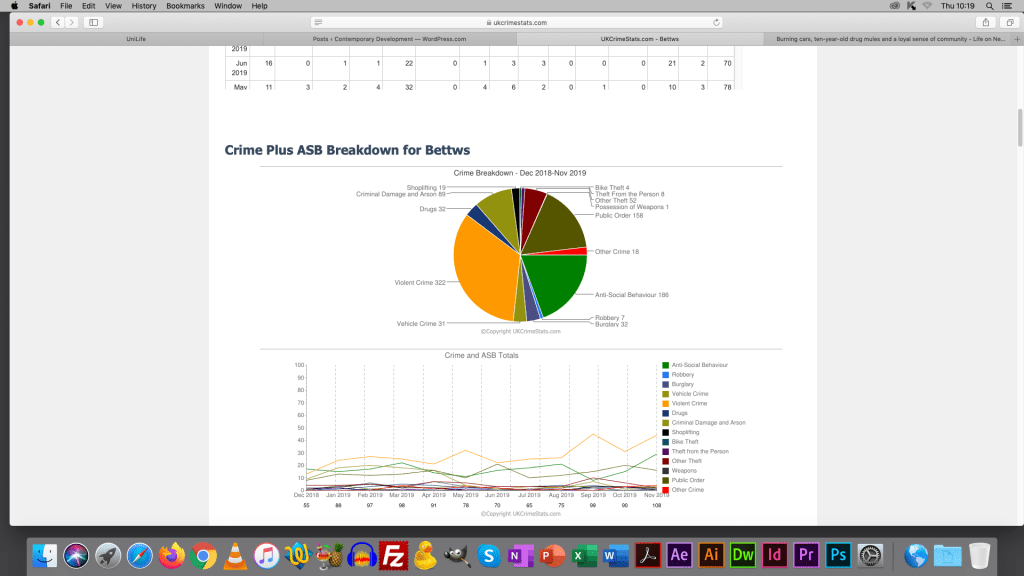
David Taylor’s story is something people would be interested in as it represents the issues Bettws have of crime and anti social behaviour. Above are some statistics of what type of crimes are committed in the area. Violence and anti social behaviour are the most prominent, which is the issues David Taylor struggled with.
Criminal Offences
Rate of all offences per 1,000 population is the sum of all criminal offences. Data is collected by Gwent Police force and is a snapshot in time and therefore is not comparable with Home Office police recorded crime.The number of offences per 1,000 population in Bettws has remained relatively constant with the rate of 66.6 recorded in 2015-16. This is below the Newport average which has increased from 77.34 to 86.37 for the same period but above the Wales average which has increased slightly from 57.35 to 58.95.
Anti-Social Behaviour
Anti-social behaviour (ASB) is any aggressive, intimidating or destructive activity that damages or destroys another person’s quality of life. The legal definition of ASB is found in the Crime and Disorder Act 1998 and describes ASB as “Acting in a manner that caused or was likely to cause harassment, alarm or distress to one or more persons not of the same household”.
ASB doesn’t just make life unpleasant; it also holds back the regeneration of disadvantaged areas. It creates an environment where more serious crime can take hold and has a negative effect on many people’s lives.
The rate of ASB incidents per 1,000 population has decreased in Bettws from 82.0 in 2013-14 to 56.3 in 2015- 16. This rate is now comparable with the Newport average which has increased slightly from 54.4 to 56.2.
Project Proposal
For this module, I am doing a group project with Lowri Harris and Meg Feeney. We decided to do a documentary film, as it is something we wanted to improve our skills on. I have done documentary film in previous modules individually, but found it quite difficult to do it alone as there are many different aspects of it. We are going to create a film based on the life if David Taylor, 29 years old from Bettws, Newport. He is a well known character in the area, when he was younger he was known for being troublesome. But now, he is a reformed character has created a nonprofit organisation that help the youth get into music and stay out of trouble. The film will be interview based, where we find out about his personal life and why he has changed his life for the better. We will also include a variety if b roll of him, including him busking in Newport which he does regularly.
Module Aims
Aims
To ensure students are aware of the latest developments within photojournalism.
To equip students with the knowledge and skills to be able to apply cutting edge
advancement with the industry to their own practice.
To understand how the industry currently functions within the framework of new
technologies, theories and methods.
Synopsis
The module will address the current and potential future technical advances within
creation and distribution of images and media content.
Students will demonstrate an understanding of current developments within the industry
through a practical assignment.
The contemporary structure of the industry will be explored through a series of seminars
and workshops empowering the student to distribute their work within a relevant
framework.
New innovations in practice such as participatory photography will be taught in class
sessions to enable students to engage with subjects to tell their own story.
Learning Outcomes
- Produce practical work that identifies and references current changes and developments in photojournalism. in relation to their own professional direction.
- Demonstrate a critical understanding of how current developments are affecting
and impacting upon contemporary photojournalism.